

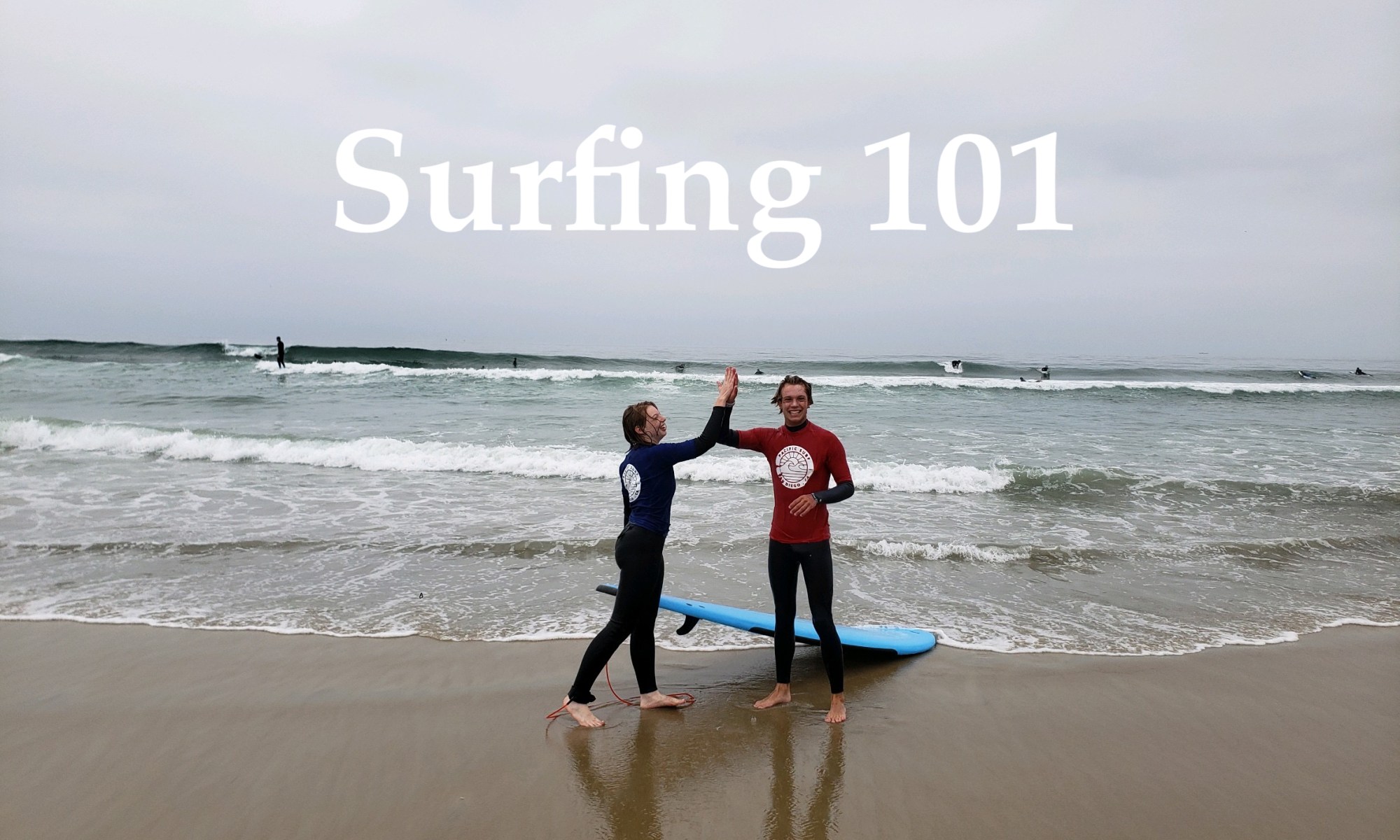
Truthfully, this blog is just as much for me as I hope it will be for other beginner surfers.
After epically failing when renting a board and going out by myself for the first time on a trip to Ocean Beach, I opted to take the second surf lesson of my life to ask all the questions I had whilst getting pummeled by waves and fighting back tears the day before.
Here are the top 10 game changers I learned the hard way, so you don’t have to.
1. How To Carry Your Probably Eight-Foot Board
When you go to rent a board and reveal you’re a beginner, the rental shop will certainly and rightly give you the biggest styrofoam board they can scrounge up. As great as it will be for learning, you’ll feel imposter syndrome carrying it around if you don’t know how.
After assuredly looking like an idiot on my first-day solo, I learned if you can’t get your arm all the way around your board to carry it by your side, the next best option is carrying it resting on top of your head.
2. Strap Placement
Once you’ve made it to the shore and are ready to go, velcro the strap around the ankle of your back foot when you pop up. If you’re right-handed, your back pop-up foot is likely your right foot.
3. Stingray Shuffle
I was shocked to hear how prevalent stingrays are in California. Shuffling your feet along the sand while wading out in the water allows stingrays to sense the vibrations of people’s movements and get out of the way if you happen to move near one. It also allows them to flee easily if you get so close as to brush up against them (which happened to my instructor during the lesson.) Stomping out to deeper water is a recipe for stepping on top of one and getting stung as the stingray’s only defense mechanism. Think of the stingrays (and yourself) and do the stingray shuffle. *cue music*
4. Keep Board Perpendicular To Waves
As you make your way out to the surf and set your board on the water, keep it perpendicular to the waves. This is the easiest way for the board to travel over the crashing water. Turning it even the slightest bit toward parallel to the waves or parallel entirely will cause the board to flip over or smack into you as you try to keep it from flipping over. As my instructor so aptly put it, your board can easily double as a weapon against you if you’re not careful.
5. Letting Waves Go Past You
Since you don’t go for every wave that rolls by, there are three ways (plus a bonus one I’ve never done before) to let waves pass you without getting carried toward the shore by them.
- If you are able to touch the ocean floor while walking further out, you should push down on the back end of your board as the wave rolls by or even jump onto the middle to back end of the board (making sure your board is perpendicular!!). Keeping your weight on the back end allows the top of the board to bypass the wave by being above it and as a result, not get dragged back toward the shore. Think of it as bypassing the wave by more or less jumping over it.
- If you are paddling out hard and can’t touch the ocean floor to utilize the first method, you have to do a ridiculous move called the Turtle Roll. It entails flipping your board on top of you as the wave hits so that it can pass over the underside of the board (now, on top) smoothly. After the wave passes you, flip the board back over, get back on, and paddle like your life depends on it so you make some distance before the next wave hits. Here’s a video that explains and demonstrates this technique well.
- If you have a shortboard rather than a long one, you may Duck Dive (bonus method!), which involves kicking off your board in order to dive under the oncoming wave. This video likewise explains and demonstrates the Duck Dive well.
- Finally, once you have successfully paddled out to where you want to catch a wave and are facing the shore waiting for the perfect one, you can sit up straight on the middle to back end of your board with your legs dangling off each side (anyone seen Soul Surfer) and lean back as the wave hits. Doing so will allow the wave to pass under you. While you may get carried forward a bit, you can always swivel around and paddle forward before the next wave hits to get further out.
6. The Importance Of Wave Patterns
I had no idea just how important wave patterns are to successful surfing. The best waves to go for are ‘clean,’ meaning they are a single broken wave heading parallel to the shore. Unclean wave patterns can be the sole reason that otherwise solid rides go awry.
Waves moving slightly diagonal to the shore or a wave with a second wave close behind it are not ideal ones to go for. Clean, even, single breaks allow for the most successful rides.
7. Pop-Up Timing
Once you’ve dialed in on the wave you want to go for, you should propel yourself forward in the water by scooping both arms simultaneously and powerfully twice right before the wave hits you and once right as it does. Doing so allows you to get ahead of the wave just enough to ride it. If you feel yourself falling behind the wave, scoop forward again before you pop up. If you’re too far ahead, lean back slightly and wait a moment before you pop up.
8. Consistency Is Key
Practicing surfing in the broken wave section repeatedly is the best way to nail your wave selection and pop up before you move out into riding the tube, (which I have yet to do and am certainly a long way from doing.)
9. You Can’t Surf Just Anywhere
After kindly being corrected by lifeguards and embarrassing myself numerous times, I learned some beaches have designated surfing areas you must abide by. Asking a surf shop attendant, a surfer, or even just surveying the area and signs before paddling out are essential for keeping yourself and others safe and not to mention avoiding a courteous but humiliating call out.
10. Wrap Up Your Leash
After a hopefully successful day of surfing, unstrap your ankle from the board and wrap the leash (or cord) around the back end of the board before you ever leave the water. The buoyancy of the board in the water helps wrap the cord more smoothly and the proximity to the water makes for a simple sand clean-off process.
I highly recommend one-on-one surfing lessons your first or even first few times to learn all the techniques of popping up and balancing on your board. Taking lessons from two different instructors proved beneficial by exposing me to distinctions in the practice. While a correct form is essential, my limited experience has taught me that successful rides are a matter of feeling out one’s balance and trial and error more than anything else. I found my best rides transpired the less I thought about the specifics of what my body was doing and just let it do what felt right. (Conveniently vague and unhelpful, right?)
 Sierra Sage
You go girl!
LikeLike